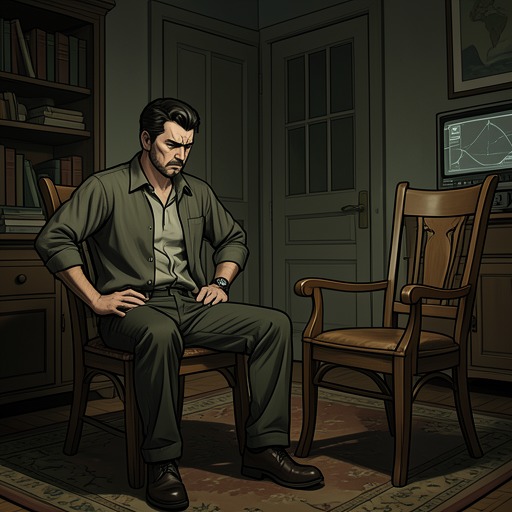
Fletcher and Edison’s Brothers-in-Law Relationship
Big BrotherFletcher and Edison’s brothers-in-law relationship moves from strained cohabitation and contemptuous judgment toward an uneasy but consequential recognition. As Edison, the brother of Fletcher’s wife Pandora, lives in their home and attempts to lose weight, Fletcher sees him as a burden and a bad influence; by the time Edison reaches his goal, Fletcher has to confront how badly he misread him, even as the strain has helped fracture his marriage to Pandora.
Domestic Friction and Divided Loyalties
Edison’s presence alters the intimate geometry of Fletcher’s household. One night, after Pandora and Edison have talked loudly enough to wake Fletcher, he comes to the doorway in his robe and asks Pandora whether she is coming to bed. For Pandora, the tension is not simply that she and Edison have disturbed her husband. Fletcher’s entrance recalls their childhood, when their father Travis would interrupt a gathering between siblings and send them back to homework or silent chores. Pandora feels that the old arrangement has been repeated: she and Edison have been talking as siblings, while Fletcher, her husband, has become the outsider. The conflict is not only about noise or bedtime, but about who has a claim on her attention.
Their strained coexistence is also visible in the ordinary routines of the house. When Pandora returns from work, she weighs whether to stay upstairs with Edison or go down to the basement to greet Fletcher. He is often absorbed in feeding timber into a loud table saw, wearing goggles clouded with sawdust; if she waits for him to finish, he may only nod before starting another cut. Later, Fletcher may emerge to make dinner while Edison talks from his maroon recliner. Edison’s stories about jazz can fill the room, but his loquacity does not amount to emotional openness: Pandora observes that he can talk all day without letting anyone know him better. The brothers-in-law share space, but their household roles and forms of communication remain sharply unequal.
Competing Ideas of Care and Responsibility
Fletcher objects not only to Edison’s dependence on the household but also to what he believes that dependence is doing to others. He tells Pandora that Edison thrives on Cody’s kindness, while using it up; Pandora counters that Cody gains piano lessons and practice in compassion. Fletcher rejects that defense, arguing that what Cody is practicing is pity, which will not help Edison. The exchange makes their disagreement about care explicit: Pandora sees kindness and connection as meaningful in themselves, while Fletcher measures care by whether it produces independence or improvement.
They also disagree over what Edison’s weight and conduct signify. Pandora describes the looks Edison receives in public, especially in supermarkets, where his piled-high cart makes her feel surrounded by disapproval. Fletcher recognizes that Edison draws on Cody’s goodwill, but frames the relationship as exploitation. In a later argument about what the children should learn, Fletcher says he wants them to be solid, work hard, do their part, and expect neither a shortcut nor a handout. He blames Edison’s stories about talent and an unconventional career for influencing Tanner to leave school, emphasizing that Edison himself quit at seventeen. Pandora turns Fletcher’s own standard of effort back on him: Edison has refused surgery and has endured months of skipped meals in pursuit of weight loss. Fletcher dismisses this as undoing damage Edison created himself, likening it to carrying bricks across a yard and then carrying them back. Their dispute exposes a gap between Fletcher’s ideal of disciplined responsibility and Pandora’s view that Edison’s difficult, imperfect effort deserves recognition.
Marriage Under Strain
Edison’s stay intensifies an existing conflict between Pandora’s obligations to her brother and her marriage to Fletcher. Fletcher tells her that leaving for a year would mean being out on her ear for good, then accuses her of making clear who matters most to her. He objects to discussing their private affairs in front of Edison, but says Pandora no longer understands what belongs to their marriage; he also fears that she will report his words to her brother inaccurately and make him seem more ridiculous and villainous. Pandora tries to defer the conversation until they are alone. Fletcher instead says he wants a divorce, a word he had not used even when he had insisted that Edison leave the house by the date of his plane reservation.
The confrontation makes Fletcher and Edison’s relationship part of a larger family system rather than a private dispute between two men. Fletcher’s resentment is directed at Edison’s presence, but his accusation is fundamentally aimed at Pandora: he believes she has crossed the boundary between sibling loyalty and marital obligation. Edison’s role as witness sharpens the rupture. The intimacy between brother and sister that makes Pandora feel responsible for Edison also becomes, in Fletcher’s eyes, evidence that she has ceased to protect the marriage.
From Contempt to Public Recognition
At Edison’s Coming of Size celebration, the brothers-in-law’s antagonism becomes part of the evening’s public ritual. Edison reminds the guests that Fletcher had doubted the resolve of his supposedly broke, homeless, self-indulgent brother-in-law, and recalls Fletcher’s wager: if Edison reached 163 pounds, Fletcher would eat an entire chocolate cake in one sitting. Edison, who had once weighed 386 pounds, now uses the bet to turn Fletcher’s contempt into a test Fletcher must honor. He invites Cody to bring out the cake and asks Tanner to help her carry it.
Fletcher does not evade the challenge. Before the party, Edison has changed clothes three times, emerging in khaki cargo shorts, a rayon shirt, bright white Nikes, and showy sunglasses; the effort marks the occasion as a public milestone rather than an ordinary bike ride. At the celebration, Fletcher admits that he underestimated Edison. He takes an oversized first bite, and the guests cheer as icing smears around his mouth—the very spectacle Edison had anticipated. Fletcher acknowledges the weight-loss achievement by accepting the consequence of his wager, while Edison turns the old insult into shared entertainment. The gesture does not erase their history of conflict or repair the marriage crisis, but it changes the terms on which Fletcher can regard Edison: the man he treated as incapable of persistence has, in fact, gone the distance.